
President - Divine Life Society
OM Sri Vishwanathaya Namah
OM Sri Shankaracharya Namah
OM Sri Sat Guru Sivanandaya Namah
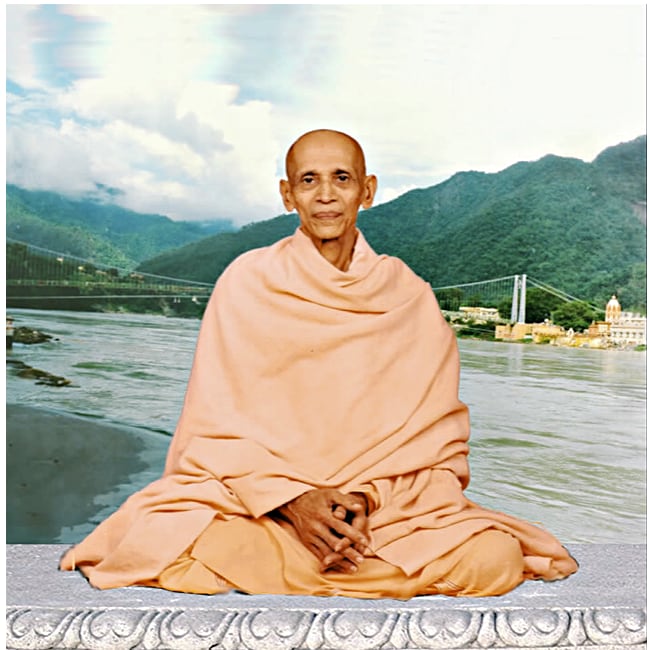
Sri Swami Chidananda (1916 - 2008) was 'boldness of spirit behind a slender appearance, irreversible command of heart behind a benign face, unwavering peace of mind behind dynamism of action, impersonal detachment behind personal love and care, all at once in a single person'.
He joined Sri Swami Sivananda's ashram in 1943 when he was 27 years old. He has devoted 65 years of service to the mission of Sri Swami Sivananda.
Sri Swami Sivananda said about his spiritual son and beloved disciple: 'Chidanandaji is a jivanmukta, a great saint, an ideal yogi, a parabhakta and a great sage. Swami Chidanandaji is all this and much more. He was a great yogi and saint in his previous birth. His lectures are the outpouring of a saintly heart. The revelations of intuitive wisdom. He is a practical Vedantin. His words have tremendous power. He was born to fulfill a great mission.
The ideas and teachings of Jesus Christ made a deep impression in his heart and he was able to synthesise them with all that was best and noble within Hindu culture.
Swami Chidanandaji Maharaj (02 February 1990)
Human conduct should result in human welfare. However, everything is governed by ego and ambition. Most are believers of the hedonistic philosophy - ‘eat, drink and be merry’.
Problems have to be looked at with in-depth vision, with analytical perception. True peace is a positive living experience, so powerful nothing can alter it, or disturb the person experiencing it. Peace cannot be momentary. One whose heart is full of That, which is of the nature of fullness, is at peace, not agitated ever. Desire is the enemy of peace and desire is the nature of the mind.
There are three types of desires:
A rainbow cannot be possessed, but is enjoyed by everybody. The more we pander to the desire and try to satisfy it, the more fiercely it burns. This is the main source of our ‘ashanti’. We also constantly tend to blame others, something outside of ourselves, for our restlessness. Whereas if your ego constantly requires satisfaction, you yourself are the cause of your restlessness.
The Hindu concept of life is to attain that perfection where we shine as something lesser, good, beautiful, peaceful.
The worth of your life, the true value of your existence here on earth can only be measured by the good that you have done to others, by what you have put back into society, and not by what you have extracted.
Living a life of selflessness, you will attain true peace.
Meditation solves the problem that menaces the individual making him look upon life as fraught with bitterness, pain and suffering. It transforms life once again into a meaningful and a deeply significant and wonderful gift from the Supreme to the human soul. The key to this transformed view of life and the transformation in the very experience of life is, in a single word, meditation. The problem of death is solved, for meditation bestows on you all awareness of your true nature, the realization of your real Self which is deathless and immortal. Thus it takes you beyond all fear of death and frees you from terror.
Outwardly, due to the limitations of your physical frame, you are finite. Your powers also are limited. Your intellect is bound by the necessity of basing all conceptual activity upon name and form, for without name and form mind cannot conceive of any idea. Therefore, the very function of your intellect is possible only within the framework of name and form.
Enquire who you are, know thyself and be free. That transcends all of the sorrows, miseries and limitations which this earth life imposes upon you. In one word the goal of your life is the realisation of the Supreme Reality. You may call it what name you will. Call it the Self, call it Cosmic Consciousness. The achievement of this alone will give you permanent happiness. The ancient vedas have from time immemorial sought to bring home to mankind the oneness of all life. We have a declaration in the vedas, duality is the cause of all sorrows.
The Siva Yoga Divine website is dedicated to preserving the teachings of Sri Swami Sivananda, founder of the Divine Life Society and the Sivananda Ashram, Rishikesh, Himalayas.